

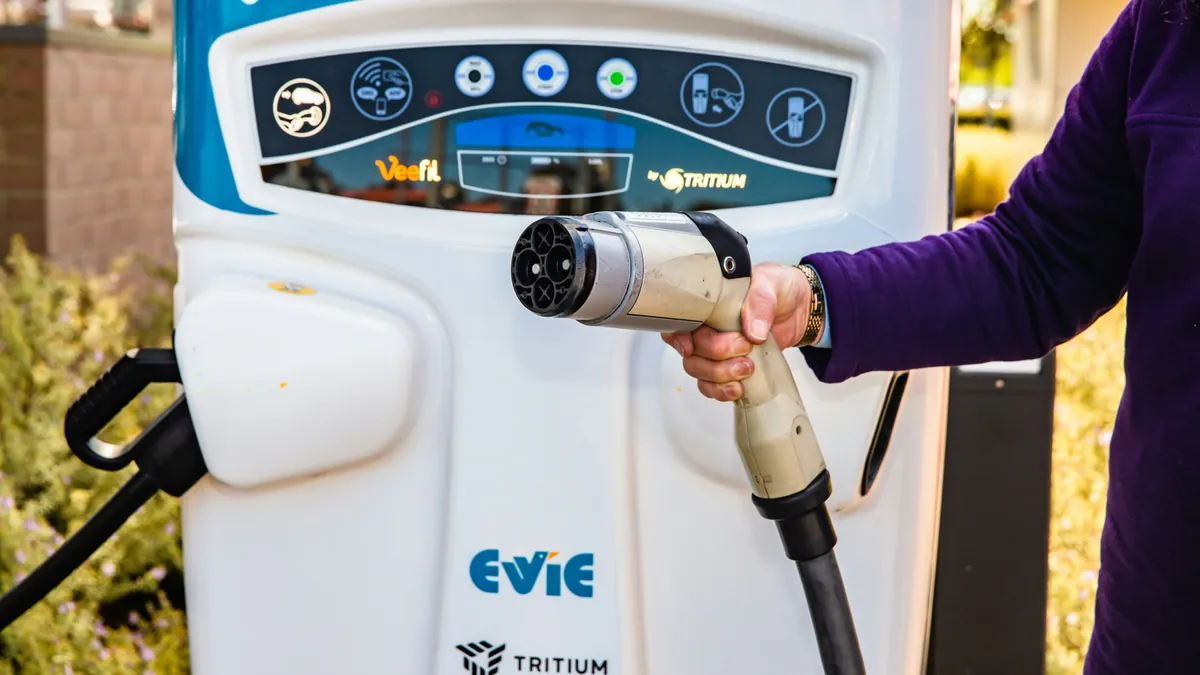
Tarun Kapoor, adviser to the Prime Minister, said on November 20 that connection charges levied by power distribution companies are a hurdle for charging operators, with the problem sharpest at fast-charging sites that need 100 kW or more. "Discoms sometimes are not very cooperative," he told the Society of Indian Automobile Manufacturers' (SIAM) first Growth and Readiness for EV Infrastructure Dialogue (GRID 2026) in New Delhi. His proposed fix is a designated officer at each discom to clear connection issues for charging stations.12
In Kapoor's account, the bigger share of a station's cost lies behind the meter, where discoms at times ask for large payments. He argued that utilities, with India heading into a power surplus, stand to gain from EVs as a major new source of demand. Weak usage is a second problem: some public chargers are used less than 1% of the time, which leaves operators struggling to cover upkeep. He also wants more daytime charging at workplaces and other public spots, so that the network does not depend mainly on overnight charging at home.1
Of the Rs 11,900 crore PM E-Drive outlay, Rs 2,000 crore is meant for charging infrastructure, covering up to 72,300 public chargers plus swapping points. Kapoor said the government would be willing to commit further funds if required.13
The dialogue was held as SIAM's first National EV Charging Day, organised with support from the Ministry of Heavy Industries. Heavy Industries Minister HD Kumaraswamy said more than 30 lakh EVs had been sold under PM E-Drive as of September 30, 2026, and that funds had been sanctioned to states and oil companies for 8,610 charging stations. He said the number of chargers installed should not be the only measure of progress: stations have to be working, accessible and reliable, and the network has to reach small towns, villages, industrial clusters and tourist circuits. He said the Centre would set policy, states would help with land and approvals, and industry would bring investment and technology.23
Hanif Qureshi, Additional Secretary at the ministry, said about 9,000 chargers were being set up under PM E-Drive, and that states had been given sanction for roughly Rs 900 crore of charging projects. He described guidelines for a charging station every 25 km on highways, and facilities for buses and trucks every 100 km.2
SIAM President Shenu Agarwal, who is also managing director and CEO of Ashok Leyland, said EV penetration had risen from 0.7% in FY20 to 8.2% in FY26, and that charging should be treated as national infrastructure in the same way as roads, ports and power. He pointed to India's 7.7% real GDP growth in FY26 as support for that build-out.24
Financial Express noted that charging remains a key challenge chiefly for electric passenger vehicles, a segment that has lagged two- and three-wheelers in going electric. Ather Energy was among the companies at the event, along with Chargezone, Statiq, Tata Power, BHEL and JSW MG Motor India. Officials from Delhi, Uttar Pradesh, Tamil Nadu and Kerala also discussed state plans, network uptime and land availability.12